
May 7, 2026
Challenge me.
She said “Amanda don’t you want to be the chief executive of the holistic and wellness department”
I said, “no I don’t. I do not want to be the chief executive of anything”
Especially if the current structure and my role as a supervisor was burning me out.
I was naming it all around me and no one did anything except tell me to take an off day or cry when my feedback hurt their own insecurities.
Imagine places where we all get to be known by our first names. To be seen and also challenged to grow as we are vs. another “promotion”
There are holes in every organized institution. I don’t share this because I hate these places and the structure, I share this because many of these places don’t want you to see the holes that are presently there. They don’t want to even acknowledge them because once acknowledged other people might start seeing them too
There are holes in everything.
And they are often swept under the rug through performance, compliance, and quiet to protect the image.
I say this as someone who actually loves mental health. I love being a therapist.
Yet many of the mental health practices I worked in didn’t actually challenge me. They weren’t focused on growth into the higher “roles,” they were focused on fast paced compliance, conformity, control, gossip, secrets, and fear.
Creating more management positions because no one could actually hold what was happening
I keep calling out the holes until you recognize it not as criticism but as love.
Challenge me. With love.
So I turn that inward because what’s happening on the outside is inside
Eventually I realized the attack I had against myself was also love.
A challenge.
As soon as I started to see that my own anger/ attack on self (on my holes) was from challenge and love I realized I could take it. I no longer defended or protected.
I realized I could acknowledge, agree, and say yes I do that. Not I need to change it yet, but yes that’s happening. And the holes impact others (me). I can hold it, soften and shape it. I can take my own fight and do something with it
Without collapsing. Without shame. Without needing immediate repair. Just my own honesty.
Your nervous system is not your enemy. It’s your salvation. Your fight is not evil. Your anger is not a weapon. Your fight is life trying to move. It’s mobilization and information
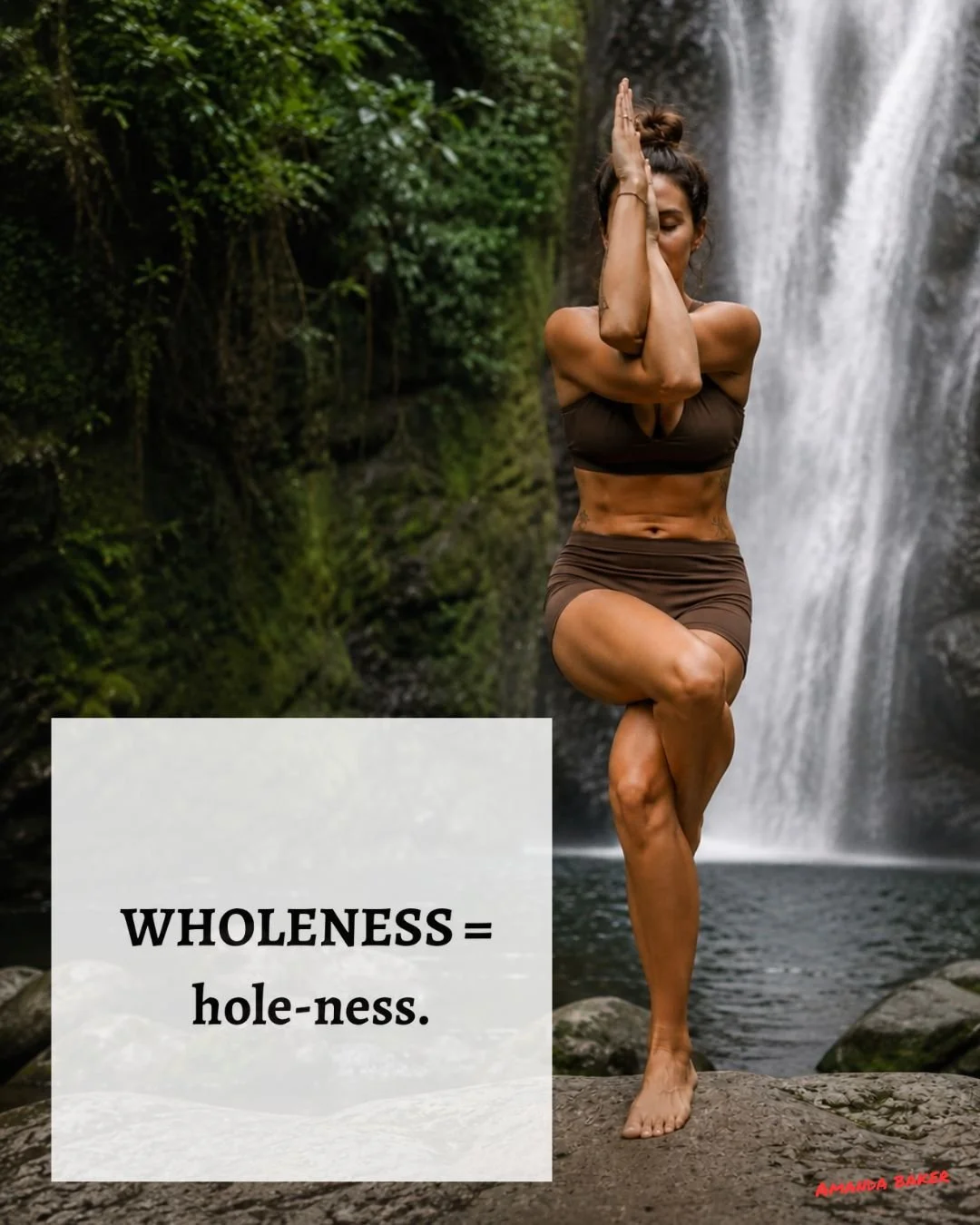
My anger, rage, hurt, my fight became shaped, molded, formed inside. And out. The way eagle pose in yoga holds me, the way eagle pose in yoga balances me, the way eagle pose in yoga challenges me, constricts, contorts. The way eagle pose in yoga…in my own body, loves me.
I had to stop fighting my own body long enough to feel it supporting me back
suddenly I realized, I am not the only one holding myself. The earth is holding me too.
We don’t need to rush to a solution but perhaps stay in the chaos a little bit longer and name it for what it is, chaos and I’m a part of it
Chaos disrupts and destroys when it is denied. Chaos moves and stabilizes when it’s allowed, understood, cared for as a natural life force.
You keep searching for the medicine. Meanwhile, Mother Earth is right here. All around. And inside you.
You do not need to become worthy of belonging here. You already belong.
You don’t need the medicine. You are it. Together with life force. With this earth.
And it’s all free.
That’s wholeness.
Hole-ness.
I thank God for the holes.
YOU AMAZE ME. I love you
May 2, 2026
I never actually left.
I never actually leave.
All the info out there, I fell for it. The propaganda that had me believing I abandon myself and others.
But when I really look, really see, I don’t leave in the way I think I do.
Everything I thought I “left” came from the realization that something had already shifted
and no one had the freaking courage to actually say it.
They already left.
They were already gone when they stopped abiding by their original mission. The one set up at the beginning, the one that we agreed to.
The jobs that said “we’re not like the other places” or the ones who said “I’d burn this place down before becoming corporate”
and then slowly became exactly that..
I was never fully pleasing, I was believing what was being told to me. I was putting everything into what I love. My “overworking” was from passion whereas now I use more discernment of where to place my heart. Now I can be and I can observe
I have no problem with things changing. My strife is when those do not own the change. As soon as you become dishonest with yourself, something leaves in you
I likely stayed a little longer than I needed to. I had moments where I overrode what I felt. But I didn’t betray myself in the way I was taught to believe.
Physically leaving doesn’t mean rejection or abandonment if energetically it’s already gone. Leaving doesn’t mean quitting or abandoning if the original agreement is no longer being fulfilled.
And so as the truth arises, the discrepancies reveal themselves … I walk away, with grief in my hand and dignity in my heart.
Now I look at that little girl that was fed “abandonment wound”
and she says to me:
“You never left me.”
“and they never really left you.”
She shows me how she sees everything I have created has been done with my heart and the core of her. which is me.
She says “you are there in all of it. It’s you. It’s me.”
Something in them left
and they don’t even know it yet.
I forgive for abandonment being thrown around within the therapy/mental health, spiritual, and self-help/personal developmental space and, most of all, for believing it.
And maybe my past heartbreaks would have “healed” better if I never heard the word abandonment and my sadness, grief, hurt were left to be just that. Do I really need to focus on whether it’s because of “abandonment?” What matters is the feeling happening inside. That I was sad. Alone. Confused. Scared. Grieving loss.
Feel the feeling. Abandonment is not an emotion
Abandonment is “the act of permanently leaving, deserting, or giving up a person, property, or right with no intention of reclaiming it. It involves a total surrender of interest or responsibility.”
In my own reflection and exploration, most of the time this is not what is happening to me nor what I am doing to myself…most people are not “giving up” and deserting (sometimes they are and even then it’s likely because they are so consumed within themselves or disconnect/shut down within themselves)…
It’s a loss. And yes many times unexpected while it’s still just that - a loss. it’s grief, it’s hurt, it’s sadness (and also love inside of you).
My experience is that in focusing on abandonment, it gets paired with betrayal. So it’s no longer just the act of being permanently left… but more so it’s I’ve been left and they/I should not have done that. That should not have happened. or it gets personalized to “they left because of me” or “I leave myself by chasing, pleasing, performing”
Though what if this type of “leaving yourself, the one of being a bit performative/pleasing/chasing” is simply because you BELIEVE in what you are doing. You like the person, the job, the environment, the thing you are choosing…you are engaging in from an internal feeling or interest, desire, passion, joy, fun, etc.
To me that’s not self-abandonment, maybe it’s trying too hard or staying for too long…but when accepting of that and you are okay with that stance…“I am not self-abandoning. I am choosing you in these moments and am willing to take responsibility if later I realize how my pleasing/performing may impact myself and others…”
Hopefully you realize when it is no longer in alignment
So to me self-abandonment is more a self-deceiving…it’s shutting down/disconnecting, complete disregard for what you agreed to without later conversation and self-responsibility, not following your own values permanently. It’s avoidance of your own self permanently.
Because really the thing is, do you come back? Check do you come back to yourself and the things that are important to you, the people that are important to you? The agreements made and that have possibly changed?
We are not perfect, so do you come back with integrity, humility, compassion, remorse, responsibility, forgiveness. Willingness to rewrite something or if no longer mutual or being met then making new decisions for yourself.
When we accept the loss and that something has changed…we can feel the disappointment, hurt, anger, loss, loneliness, etc. as it is (without the story). We allow the experience, the sensations, the emotions inside to be as they are vs. focusing outward.
So could it be that you never fully leave/abandon yourself nor really abandon others (including places, environments, presence)?
Or perhaps you came to believe that abandonment story and so you’re living that out…and you may have some cleaning up to do…
There is no wrong. There is always forgiveness. I forgive them all. I forgive me. I really forgive me for absorbing the intensity of “abandonment” that is associated with the emotions of grief, loneliness, fear, anger, hurt, loss, and the biggest one betrayal.
I did not leave, I was just the last one still being honest.
I never fully betrayed myself. I never was fully abandoned by me. I was always there.
I am here.
There is always hope.
That it keeps getting better.
and because of this I show up better for myself, for others - with less projection and greater presence.
YOU AMAZE ME. I love you.
April 11, 2026
The way I pick things apart is such a habit. It’s so natural for me to find the holes…it’s a true blessing and a curse.
This week I found myself starting to pick apart Internal Family Systems model. Actually I’m not even picking it a part, I need to be honest with myself and name it for what it is. It’s a knowing without explanation, just a light-bulb knowing of “oh shit, what I love is not perfect, here are the holes.” That’s love right? Loving the contradictions, the hypocrisy, the weaknesses, the talents, the beauty. I have loved IFS for years…and as I call this out I am in no way changing my love for it, it’s a realization for me to tweak how I apply it for myself and with others.
My realization came from this instant knowing that “something is missing.” The language of “be with your parts, witness them, appreciate them” places us outside. It’s another example of a way we are placed outside of ourselves and potentially “bypassing” our emotions and our parts.
This came about because I started to ask….
How can I appreciate something if not in the full feeling of appreciation? I found myself “appreciating” my parts from the intellectual level or the performance level because I know what one is “supposed to do in the model” and it FELT so completely disingenuous in that moment…
Instead of appreciating that part, I was mad at this particular part for keeping me outside of an emotion (mad at the model for its design to “be with, and notice” and my intuitive side was saying you need to go INTO it.
when outside of ourselves, in observation or in awareness,…we are so close, but still not fully there. When we practice from continuous awareness or “only half in” during therapy and in healing places, my concern is, we are not preparing ourselves for the real life instances when emotions/moments become actually heightened.
The word “notice” was ingrained in my yoga psychology teacher training and trauma informed care trainings as a strategy to “regulate,” a way for us to come outside of our experiences, our sensations, and yes enhance our awareness…
And more and more I am realizing in myself how awareness is pulling me further away. How regulation is paired with “calm” or even a way to “make myself or others comfortable.”
Noticing, witnessing, being with is creating distance and maybe too much (yes we need to notice, witness, and be aware) while also there may be a need to be IN (in our emotions and in the moment of ourselves) ……we are so afraid of going into what we need to go into. We think if we fully go into an emotion or the part that it will take over and make a bigger mess or create more damage. That we cannot handle it and will not survive. We are so afraid of hurt and so full of mistrust of our own selves that the healing modalities are still band-aids that keep us from our wholeness.
I could write a whole essay on this, how I really got here, and even more of my ongoing thread of stream of consciousness, but basically what I am considering is that as we build in our “capacity” we could be getting further away, further apart, and further disconnected. So my conclusion (for myself is)
the need to merge.
Not by jumping in (while yes sometimes we will do that and that is not bad or wrong either, just be ready for the aftermath, which can go in so many directions).........we can approach merging with (our parts and our emotions, with self, the environments, others) with steadiness, care, and safe pacing….yet if we stay only in observance - which is what, in my experience, IFS and many healing modalities teach, then we are missing the full expansive emergence that comes after.
Perhaps we merge to emerge…
Meaning by actually being in the emotion and/or a part, from a place of choice and readiness, you fully connect and expand.
There are different ways this happens:
We can merge from codependency, reliance, addictive ways of being with our parts and with our emotions…..merging from past patterns and perhaps unconsciously (this will likely continue suffering with self and on others)
OR
We can merge from wholeness, connection, oneness, union with parts.
We are already doing it anyway…so after awareness there can be space to go in…
Some one here is likely codependently/addictively merged with their pain. Their intellectual, their critic, their pride, their ego, their pleasure, their sensuality, their fear, their child-like self etc. I am definitely reliant on my intellectualization….this is not necessarily “healthy” if it has the driver’s seat when I’m activated it’s going to create an inaccurate story. This story will keep me looping and potentially lead to internal criticism or even projection, deflection, and attack on another.
Sure eventually when out of it witnessing, aware, being with…is helpful here to unhook…. while also when in it, what feels good about it? You will not know what feels good and even not good unless you are connected to the feeling of it…which means you are closer to it.
Example, my intellectualization sometimes gives me pride. Being connected to the pride (in it) feels good. I feel above. I feel in control. My intellectualization, my awareness, also informs me that this is shame based pride. Meaning the pride is coming from a deeper emotion that is being protected. I am not in the shame, I am in the pride (safer). I feel good but could be hurting another.
If I go into the shame what happens? Not thought, but feeling..…I cry. I scream. I whine. I’m back to being a toddler because the shame first started there, so I need to go back. I need to go back into it and literally offer myself another living experience. To be able to cry, scream, whine, shake, curl up on the floor, and tell myself it’s okay as it is. No intellectualization, no regulation strategies, just literally allow myself to have the process. I’ve done this many times over the past year. By myself.
Typically though, what happens when you touch your shame? What happens when fully in your feelings of shame, unworthiness and inadequacy? Perhaps you barely stay there because it’s so uncomfortable or were taught not to show those emotions…so another part comes in and takes over and well yah you go to protection mode….pride as one example, awareness, projection, intellectualization, shut down, distraction…
You can witness the unworthiness and it will give you information and maybe you’ll get a little feeling from it but the “integration” or wholeness will not occur without actually fully connecting and going into it in a new way.
The same goes for love, joy, excitement, creativity.
I wonder if….we need to be in them. Inhabit them. Merge.
And to stay. To stay there long enough for it to work itself through. It will dissolve, it will transform.
In my many IFS experiences.. from trainings I have done and even being on the client end, not once have I been directed to actually go into anything.
IFS does not seem to include the aspect of actually going into the emotion. Most practitioners do not even know how to do this themselves…also the emotional inhabitation typically requires a longer amount of time.
possibly even longer than the session holds for.
And it’s wild how often I even say, “be with the feeling” or “notice this sensation” vs. be inside of it.
Here I stand corrected, be in the feeling.
Everything you want is on the other side of the emotions that we have been taught to not feel. Everything you want is on the other side of the emotion, hence…go into it.
Let the underdeveloped emotion guide you for a period of time.
Be messy.
Be uncontained in your own sacred space of self.
….it’s expansive and it’s where your energy/life force exists.
And when you merge with love, well you get to bring that to your shame. So maybe start there.
We cannot feel love, appreciation, joy fully if we are not willing to feel grief, fear, anxiety, disappointment, hurt, embarrassment and even shame.
The amount of times I’ve heard someone say, I am not going to do that thing because I am “scared to hurt them” as if we do not trust the other person to handle their own hurt. BUT really what is being said by these people is “I do not trust myself to be in my own fear” and “I do not trust myself to be in my own care for self and another” because well most people go into guilt and shame before actually being in a place of real care for themselves and another.
It’s okay to not trust yourself yet. What is it like to be in mistrust?
My take, the practitioner needs to not be scared of the emotions in order to support someone through their own emotions. We will only go as far with another as willing to go with ourselves.
If I am coming from a model that still stays close to the surface, I am creating a disservice for others. If I am coming from a place where I have not gone into the depths of my own emotions with integrity then I am creating a disservice for anyone I interact with. I will discharge the emotions outwardly because I have not fully practiced how to do this myself. How can I without the full support? What happens when our support places are only half in?
Every time I go deeper I can sense the disconnection that is outside of me, in rooms, in people, in society. I can sense models that still teach from an intellectualized, cautious places…essentially it teaches “do not push people” as if it will retraumatize them.
I do not believe it will. I believe our responses/our emotions to trauma get disrupted and it’s that disruption that keeps the loop open and keeps one hooked. It keeps us in old patterns and more prone to continue to hurt self and others.
Sometimes we need to be pushed to go back in with pacing and openness until actual completion.
I push you because I trust you.
I push you because (for the most part) I trust myself.
I say for the most part because if I make a mistake I hope to repair when told of any impact I may be responsible for.
And anything I say or offer is always a choice. I say that in every yoga class (who knows maybe there will come a time when this language will get changed too).
I will, however, not stop speaking. I will not stop sharing. I will continue to bring my truth to places even if no one hears me.
I am able to feel the appreciation for my intellectualized and aware parts now because my anger and sadness got to be felt. To go inside and get the fully sensory experience of them.
We need both, to witness and be with and also to go in.
My hope is that this comes to more therapeutic spaces so you do not have to do it alone and also not expect someone else who possibly is not ready to do it with you.
Even with this piece of writing, in this moment, I notice I am still a bit outside of it.
YOU AMAZE ME. I love you.
Check out my podcast, authentic conversations, streams of consciousness, guided meditations, tapping, therapeutic yoga and more on my Youtube (link above)
March 2025
It was 2014 and I was asked to be part of the Mission Integration Committee when I worked for Catholic Charities in their residential treatment center with boys ages six to thirteen. I apparently lived their mission well and had a “reputation that precedes me.” I did not understand what that comment meant at that time.
We were asked to write a story and present it to a small group. We were asked to write a story about our work. I misinterpreted that assignment and wrote a story about him.
As others wrote stories on the aspects of their job day to day. I wrote about Andrew. I wrote his story. He had been on the unit the longest of 12 small individual bedrooms. These were boys that wanted to be loved. I also wanted and needed to be loved. He had no father and a mother who struggled with mental illness. I was new out of graduate school and really had no idea what I was doing.
My role as a therapist was to help them with their conduct, their behaviors, their emotional expression. When someone asked me what do you do with them in sessions, I say we play.
We played scavenger hunts, cards, board games. We would go for walks, get tea and hot chocolate. We would color, paint, build things. We rarely talk about their history. Their abuse. Their neglect. We were mostly present.
These boys were placed in restraints, on-lock downs, on 24 hour suicide watch. These boys were sometimes aggressive, threatening, and unpredictable. I had my hair pulled, was slapped, and screamed at, and also I was hugged, and smiled at, and told I was loved.
One day I received a call from Andrew’s social worker and she screamed into the phone “we found his father!” His father did not even know he had a son.
This changed everything because now the focus was on reunification. His father came weekly. We met for family therapy. Eventually Andrew left residential treatment and went to live with his dad and family. I did not know if I would see or hear from again.
Though he called me. He called me and said “Amanda I need to come back for the Villa fair. Please let me know when the Villa fair is”. And I did.
This story. That I wrote in much more detail. In more eloquent words was something that at one point did not exist. One moment you think you are destined for foster-care forever and the next you find out that your father, that you’ve never met, wants you. Even if the future is not certain, even if the relationships do not work out, anything can change in an instant.
Bill McCarthy is the executive director of Catholic Charities and he will be retiring this year. Back in 2014 I was asked if he could read my story at their annual dinner celebration. I gave him permission to read my story and I did not attend. I chose to not attend. Why? Because I was scared of the spotlight. Of the recognition. It was not about me and it being my story. It was about THE STORY.
A story of hope. A story of change. A story of impact. The impact between Andrew and I. I was only a piece of it.
The story is not the job, your responsibilities, what you do, or even how you do it. The story is the impact. The story is the connection. The story is the beginning, the middle, and the end.
The story gets rebirthed a thousand times in millions of different ways. The story is bad, is good, is short, is long, is too much, and not enough. The story is always evolving. Your story, Andrew’s story, deserves to be heard.
Your impact deserves to be experienced.
My fear of recognition is also my desire for recognition. And when you accept both, that you fear it and also long for it, when willing to say yes to all of you, everything changes.
YOU AMAZE ME.
December 2023
We used to sit with only a few feet between us and here we are 2,408 miles apart. Still twelve years apart in age. She is now 23 and me, 35. There used to be a power difference. I, a licensed clinical social worker, and she was a student. We met for the first time in the school cafeteria. I was a contracted clinical therapist for a local public middle school. The school was not required to provide me with a formal, clean office, just responsible for providing me with a room to meet with students who were referred for social and emotional therapy. I ended up that first year with practically a storage room for space just off the side of the cafeteria.
Thousands of miles apart, meeting again now, through a video screen. We both signed on around 3:00pm EST, 12:00pm PST. Her name, Imani George (originally from Baltimore, MD). She showed up with a bright smile, long locs, and yellow accessories in her hair. She had a backdrop of swimming fish, and appeared eager and excited to talk, again, this time not to set goals or fix anything, this time to give insight, to align, as equals. The way I see it, we no longer had these designated roles to uphold, even though social work ethics may say otherwise.
We revisited our contact. Imani had friended me on LinkedIn about two years ago, long after our last contact as therapist and client. At the time I was hesitant to accept the friend request because can an old therapist be “friends” and “follow” each other on social media? I still do not have an answer, though at the same time I was extremely curious. Where is she now? How often do we, in the helping profession, get to know what happens to clients who we no longer work with. Five years had gone by and I was able to see her job title “mental health technician!”
Now that seven years have gone by, she has agreed to chat with me about her experience. Imani remembers that she was referred for therapy following suicidal ideation and comments she had made to “kill herself” while at school to the guidance counselor. She shared her memory of her mother being informed and taking her to be evaluated at a local crisis center. Imani was not admitted for more restrictive observation though was recommended for weekly out-patient mental health therapy. Imani and her mother and I met for the first time when she was in 8th grade in 2014. Imani shared that she remembers being nervous and mistrusting. She states with a chuckle that having therapy with me allowed her to miss lunch and class. She recalled feeling lonely in school and did not have any friends. She recounted her experience with bullying in elementary up through middle school and being transferred to this specific school in 8th grade. She did not know anyone and she felt “like an outsider, even though I looked just like them.”
Imani reports that she was diagnosed with Attention Deficit Hyperactivity Disorder and a learning disability when she was seven years old. She disclosed that it was years before she was put into the appropriate classes for her learning needs. She detailed her struggles in class and the way teachers viewed and labeled her as “off-task” when in reality she was struggling with her comprehension. She bravely told me that she was considered “dumb” and her educational testing led her to believe what others said about her was true. She said other students called her “bricks,” which she believed meant “dumb as bricks.” ADHD along with a learning disorder that is not properly accommodated can easily lead to emotional challenges, isolation, depression, irritability, low sense of self, and more.
During our discussion Imani was pleasant and bright in her demeanor. She displayed eye contact and poise. She was open in sharing her favorite memory of therapy with me, a time in which she was able to create and decorate an Easter basket. I told her how she challenged me as a therapist because she often questioned the value in some of the activities and topics we discussed. Many times the students teach me more than I teach them.
Imani graduated from middle school and continued to meet me at a local McDonald’s so we could ensure our sessions continued. She walked almost a mile on her own. She shared that she remembered I used to have dark hair and looked like “Avril Lavigne.” Imani enjoyed design, make-up, and longed to belong.
Eventually we no longer could sustain holding sessions at the local McDonald’s and it was difficult for her to get to the office. I remembered once she called me by phone while I was in the office in an attempt to have a session. She was raised by a single mother who worked full-time and was not able to drive her to the office. I remember the pleas to be seen. Heard. And understood. Feeling helpless, powerless, and uneasy. It’s in those moments that our humanness aligns. I was also juggling a large caseload, paperwork, and the verge of burnout. I wonder now if I could have made more time for her? We did not see or talk again until her request on LinkedIn. During our course of time working together she knew I got married, she knew me when I was pregnant with my son. She wanted to know my interests. She saw me as a person. I hope she knows I always saw her as one too even as I grapple with the ethical boundaries.
During the present video chat, Imani shared about her challenges in college. She noted that she did see a therapist again around age 19. She emphasized the importance of the therapeutic relationship. She said “Sometimes it will take going from therapist to therapist to find one that will really click. I still haven't found it….be patient, it’s not an overnight thing, healing takes years.”
Imani is currently a flight attendant living in Las Vega though reported that she will be leaving the job to return to the mental health field. She enthusiastically spoke about her passion for social work and aspiration to become a licensed therapist with a private practice one day. She dreams, she wonders, and she is transcending her trauma history into something of purpose to help others. Imani stated one of her favorite quotes, from the Lion King “oh yes, the past can hurt, but you can either run from it or learn from it.”
Not every client we help will have an inspiring story, though everyone we help has a story. That story is worth being shared. I often question why we pay someone to really get to know us, to see us, empathize, and offer that unconditional positive regard? Why must we require a diagnosis for our needs to be met? Ultimately they are needs; emotional connection, safety, understanding, acceptance, compassion, and love are needs. Similar to Imani’s story, needs get missed and the appropriate accommodations take a long process to obtain. Imani also recognizes the disparity within the mental health field when it comes to teens and children receiving the support they need. She states there needs to be more BIPOC therapists.
Imani says “If there is a young adult or young female teenager who reads this, I want them to know this: challenge yourself, do not stay in your comfort zone, if you want to go sky-diving go sky-diving, travel to italy: travel to italy, paint your nails black, do it. Do not overshare too much, some people have good intentions and some not so much. Privacy is protection and peace.”
This is written and shared with permission.

